Your image is the first thing she reads — before you say a word. This module takes you from body-type analysis to a complete wardrobe upgrade across every context that matters.
Below is the actual teaching content from each category — converted from the original course and cross-referenced with international styling authorities. This is what you'll learn, not just the lesson list.
The Style Bible™ — 01 · Styling Foundations
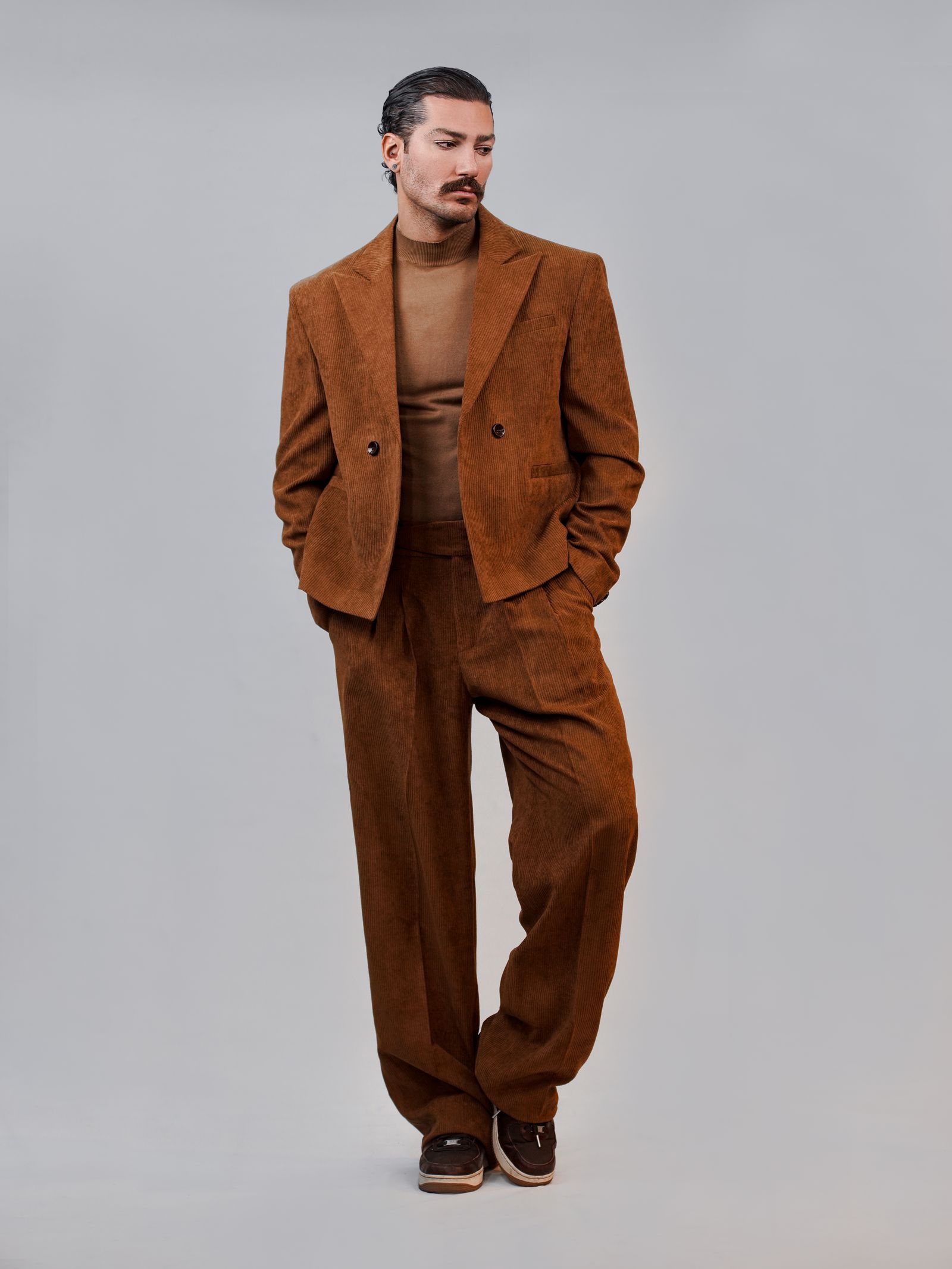
The goal. A man who can dress himself without consulting anyone — not a magazine, not a stylist, not his girlfriend. This category teaches the four capabilities that turn clothes from costume into language: self-awareness (what flatters your frame), color sense (what flatters your skin), fit literacy (where each piece should follow your body and where it should breathe), and a capsule mindset (11 pieces combining into 30+ outfits).
The intro capsule — 11 pieces, 30+ outfits. Two navy tees, two white button-ups (one oxford, one linen), one overshirt or chore coat, one navy blazer (unstructured, soft shoulder), two pairs of dark denim (one mid-rise slim, one straight), one pair of charcoal chinos, one pair of tobacco chinos, one brown derby or loafer, one clean white leather trainer, one suede chukka. That's it. Every outfit you'll ever need for a normal life comes from combining those.
Color — the only 3 that matter. Most men wear too many colors. The 3 universally flattering neutrals are navy, charcoal, and olive. Add one accent — burgundy or rust — and you have a palette that quietly beats every other combination. Skin-tone rule: warm undertones lean olive and rust; cool undertones lean navy and burgundy; neutral undertones can wear all four. Skip the color wheel until you can dress in neutrals for a month without an outfit failing.
Fit is everything — the 4 fit zones. Shoulder (the seam should sit on your shoulder bone, not droop onto your arm), chest (the fabric should follow your chest without straining or billowing), waist (the garment should taper in — a shirt that hangs straight reads borrowed), and break (the pant leg should have a single clean break at the shoe, not a puddle of fabric). Get fit right and a $40 shirt beats a $400 shirt worn wrong.
The universal matching rule — be your own stylist. Three rules replace every chart: color weight (darker pieces anchor, lighter pieces draw attention — put the dark weight on your lower half unless you want attention there), formality ladder (each outfit should sit on one rung of the formality ladder — sneaker + suit reads confused, derby + denim reads considered), and silhouette balance (a slim top needs a slim bottom; a relaxed top needs a tapered bottom). Internalize these three and you never need to ask "does this go?" again.
The 11-rule timeless canon (AskMen Style Bible, official). AskMen's published Style Bible codifies the 11 rules that build a complete and timeless wardrobe: (1) Know your body shape — rectangle, triangle, inverted, oval (decoded in Module 7). (2) Buy the best quality you can afford — one $200 pair of shoes beats three $60 pairs. (3) Fit is everything — a $40 shirt well-fit beats a $400 shirt ill-fit. (4) Build a capsule — 11 pieces, 30+ outfits. (5) Invest in navy, charcoal, and olive — the 3 neutrals that flatter every skin tone. (6) One accent only — burgundy or rust, never both. (7) Shoes make the man — the 5-pair canon (decoded in Module 6). (8) Grooming is styling — haircut, skincare, fragrance (Modules 2–3). (9) Match formality — each outfit on one rung. (10) Care for what you own — brush suits, shoe-tree leather, fold knit. (11) Dress for the occasion — never over-dress, never under-dress.
Cross-referenced with: AskMen's published The Style Bible (11-rule timeless canon, 2026 edition) + Byrdie's stylist interviews on the modern approach to body-shape styling + The VOU's Complete Capsule Wardrobe Building for Men program. AskMen's official caveat: "Style is about self-expression, not rigid rules — the 11 are a framework, not a prison."
The Barrier Protocol™ — 02 · Skincare & Grooming
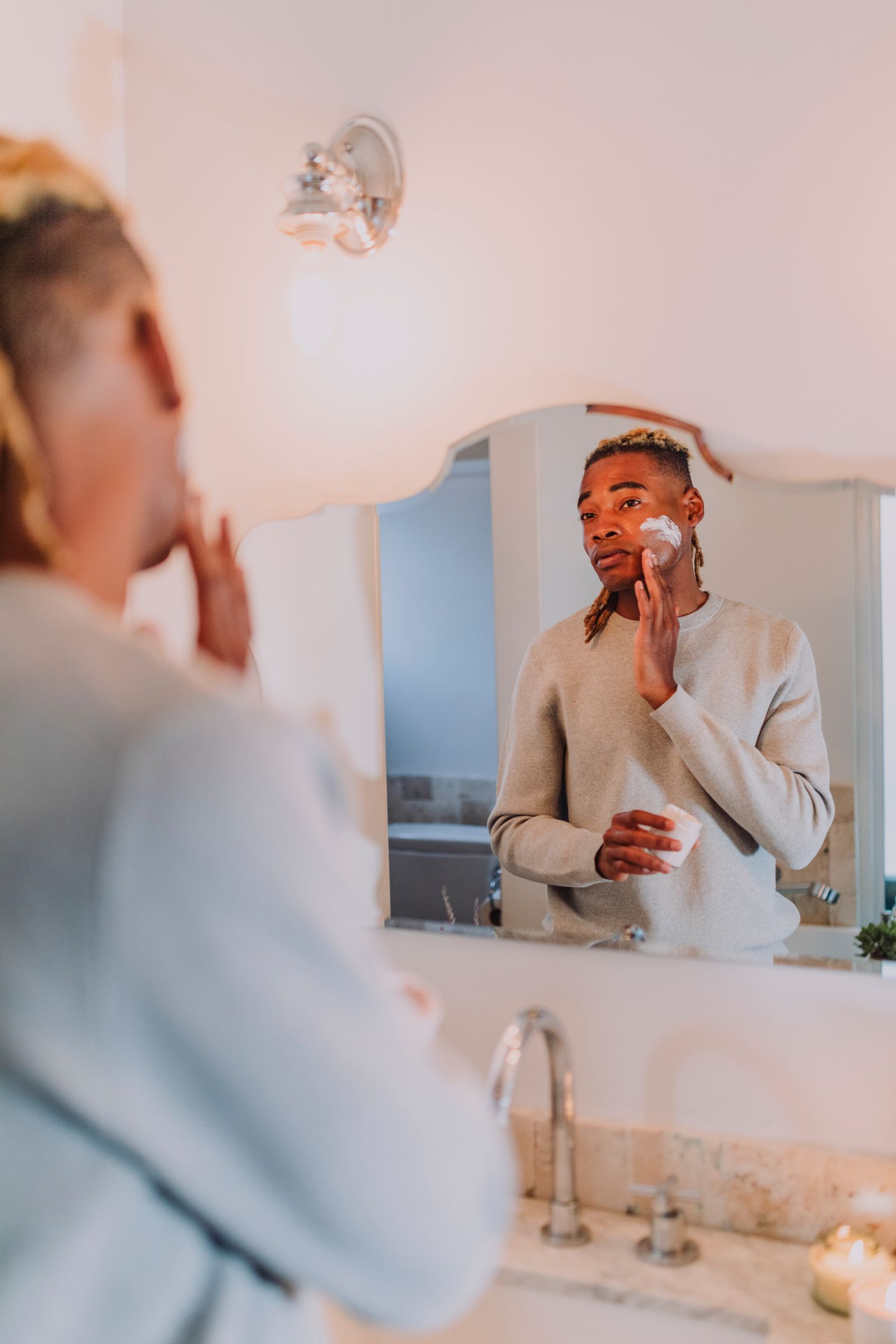
The 4-step routine that visibly upgrades your skin in 3 weeks (American Academy of Dermatology, official). The AAD's official men's skincare guide codifies the 4-step core every dermatologist agrees on. Step 1: cleanse twice daily with a gentle, pH-balanced cleanser (5.5–6.5) and lukewarm water — the AAD's official warning: "hot water and bar soap strip the skin's natural oils and destroy the barrier." Step 2: exfoliate 2–3 times per week with a chemical exfoliant (salicylic or lactic acid), never a physical scrub — the AAD's official position: "scrubs cause micro-tears in the skin; chemical exfoliants dissolve dead cells without trauma." Step 3: moisturize morning and evening with a lightweight, non-comedogenic moisturizer — heavier isn't better, it just clogs. Step 4: SPF 30+ every morning, 365 days a year, even indoors — the AAD's official statement: "UV exposure is the single largest cause of premature skin aging; daily SPF is non-negotiable." Reapply every 2 hours outdoors.
The "for men" label trap — Byrdie's official exposé. Byrdie's 2026 dermatologist-reviewed guide: "products labeled 'for men' usually mean added fragrance (irritating) and a markup (expensive), not a smarter formula." Your skin does not care about your gender — it cares about pH, barrier health, and sun protection. A $14 ceramide moisturizer from a pharmacy beats a $60 "men's" cream from a department store 9 times out of 10. Byrdie's official ingredient checklist: hyaluronic acid (hydrate), niacinamide (redness), ceramides (barrier), retinol (anti-aging, nightly only), vitamin C (brighten, morning only). Skip: alcohol denat. (drying), synthetic fragrance (irritating), parabens (controversial).
The 2026 minimalist 3-product core (Byrdie, official). Byrdie's 2026 update: most men need exactly 3 products — (1) a gentle gel cleanser, (2) a lightweight moisturizer with niacinamide, (3) a broad-spectrum SPF 30+. Add retinol nightly at 30+ for anti-aging. That's the entire core. Serums, toners, essences, 10-step routines are marketing — not dermatology. Byrdie's official position: "the best men's routine is the one you'll actually do daily — 3 products done religiously beats 10 products done sporadically."
Fragrance — the scent signature. Top notes (citrus, aquatic) fade in 15 minutes; heart notes (lavender, spice) carry for 2–4 hours; base notes (wood, amber, leather) linger for 6–12 hours. Pick one fragrance you actually love — not one a magazine told you to buy. Apply: one spray on each wrist, one behind the ear. Your date should smell you when she leans in, not when you walk in the room. Over-application reads insecure; the right amount reads considered.
Cross-referenced with: American Academy of Dermatology's official men's skincare guide (4-step core, UV-aging warning, no-scrub position) + Byrdie's 2026 dermatologist-reviewed men's skincare guide ("for men" label trap, 3-product minimalist core, ingredient checklist) + Harry's grooming guide + DermApproved's dermatologist-reviewed routine. All converge on the same 4-step core and warn against the "for men" markup trap.
The Frame Architect™ — 03 · Hair Styling
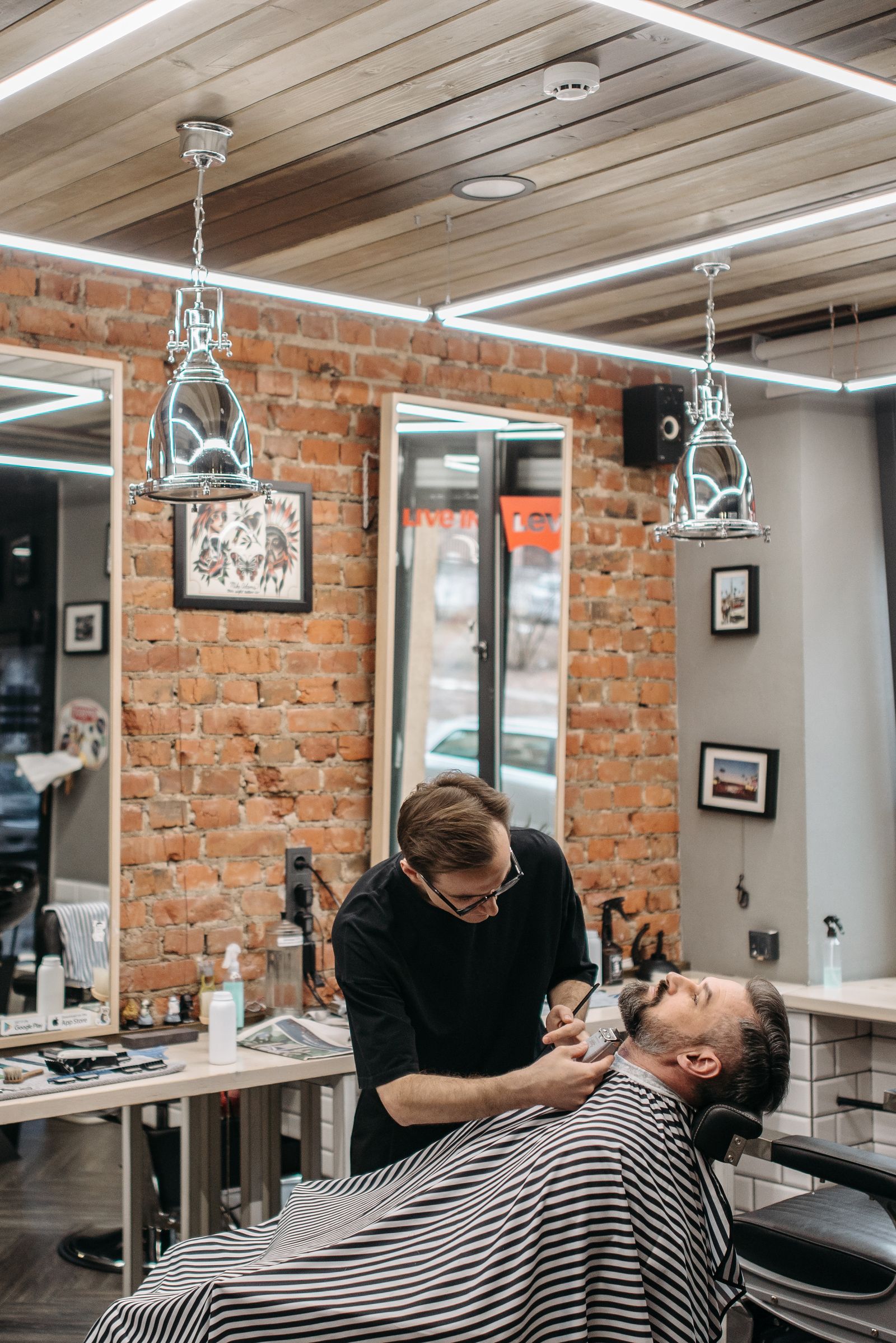
7 male face shapes — and the exact cut that flatters each (Byrdie, official). Byrdie's 2026 "How to Determine Your Face Shape (If You're Male)" guide codifies the 7 shapes and the contrast rule that beats every chart: your haircut should contrast your face shape, not echo it. Oval (slightly longer than wide, rounded jaw): the lucky frame — most cuts work, avoid covering your face's natural balance. Round (width and length similar, soft jaw): add height and angles — a pompadour or textured crop with tight sides; avoid full fringes that widen. Square (strong jaw, broad forehead): you can wear most styles — keep some length on top to soften the jaw; avoid buzz cuts that exaggerate the square. Diamond (narrow forehead and jaw, wide cheekbones): fill the forehead with a side-swept or textured fringe; avoid short sides that emphasize the cheekbones. Heart/Inverted (wide forehead, narrow jaw): add width at the jaw with a beard or fuller sides; avoid top-heavy styles that exaggerate the forehead. Rectangular (long face, angular): break the length with a fringe or side part; avoid straight-back styles that elongate. Triangle (narrow forehead, wide jaw): add height and forehead coverage — a textured crop or medium-length sweep-back; avoid short tops that expose the forehead.
Tell your barber your face shape. Byrdie's official position: "it changes how he cuts." Most men walk in and say "short on the sides, longer on top" — a generic instruction that produces a generic cut. Walk in and say "I have a round face, I want to add angles and height" and you get a cut engineered for you. Your barber spends 8 hours a day looking at faces — give him the data and he'll use it.
Product decoded — pomade vs clay vs sea spray. Pomade (shine, hold, combable — for structured styles like a side part or slick back). Clay (matte finish, medium hold, texturizing — for casual styles like a textured crop or messy fringe). Sea spray (low hold, texture, volume — for wavy or pre-styled hair, gives "day at the beach" body). Most men need two of these, not five. Buy the one that matches the cut you actually wear. Byrdie's 2026 update: skip "3-in-1" products — they do nothing well; buy single-purpose products and layer them.
The 2026 low-maintenance cuts that read younger. Byrdie's 2026 guide flags the 3 cuts that take 5 years off your face: a textured crop (tight sides, texture on top, natural movement — 2 minutes with clay), a side-swept fringe (longer top, swept to one side — 1 minute with pomade), a medium-length sweep-back (natural flow, no part — 0 minutes, just towel-dry). The 2 that add years: a comb-over (reads 1970s, reads thinning) and a flat-top (reads 1990s, reads stiff). The universal rule across all 7 face shapes: texture on top reads younger than flat; natural movement reads younger than cemented.
Cross-referenced with: Byrdie's 2026 official "How to Determine Your Face Shape (If You're Male)" guide (7 shapes, contrast rule, product taxonomy) + Hockerty's men's haircut-by-face-shape guide + Athleta's men's hair product guide. All corroborate the contrast rule (round face → angular cut, square face → softer cut) and the "texture on top reads younger" principle.
The Romantic Lead Formula™ — 04 · Date-Night Styling

The romantic-lead formula. Smart casual: fitted dark denim or chinos, clean neutral top (white oxford or navy knit), leather shoe or boot, one quiet watch. Reads "made an effort" without "trying too hard." The formula's power is that it scales — from coffee date to dinner to drinks, you swap one piece (jacket for knit, derby for trainer) and the formula holds.
The wardrobe ladder — first date to meeting the parents. First date (smart casual: dark denim, button-up, derby). Third date (dinner sharp: tailored pant, knit, blazer). Partner's dinner (shirt + blazer, no tie — read "considered" not "stiff"). Meeting the parents (shirt + blazer + tailored pant + derby — the one rung where a tie is optional but polish is not). Each rung earns the next — don't show up to date 1 in date 3's outfit.
The dark blazer that wins dates. Navy or charcoal, unstructured (no rigid shoulder pads), soft shoulder (the seam should follow your shoulder, not build past it). Pairs with dark denim (smart casual), charcoal chinos (dinner sharp), tobacco chinos (warm casual). Skip black — it reads costume. Skip structured shoulders — they read borrowed.
The universal date pant. Slim dark chinos (charcoal or tobacco). Why they pair with every shoe (derby, loafer, chukka, clean trainer), every top (knit, shirt, overshirt), every venue (cafe to restaurant). The fit rule: no break (the pant should kiss the shoe, not puddle), clean taper (the leg should narrow from knee to ankle), true waist (sit at your waist, not below — low-rise reads sloppy on a date).
Date shirt — open-collar rules. Long sleeve, open at the collar (one button undone in day, two at night), no tie. The collar shape that flatters every face: semi-spread — not the cutaway (reads stiff) and not the button-down (reads casual). The 2 colors that quietly beat every other option: white (reads considered) and pale blue (reads warm).
Cross-referenced with: Hockerty and GentInspire's men's date-night outfit guides — both corroborate the smart-casual formula and the dark-blazer rule. The wardrobe-ladder concept is corroborated by The VOU's date-to-long-term progression styling.
The Authority Outfit™ — 05 · Workplace Styling
Public speaking — the authority outfit. Navy or charcoal single-breasted suit (2-button, notched lapel), crisp white shirt (cotton, not poly blend), solid tie (navy or burgundy — no patterns), polished black derbies (cap-toe, not brogue). The combo earns attention before you open your mouth. Why it works: dark solids read serious, white reads crisp, polished leather reads meticulous. Anything louder reads "compensating."
Client meeting — win the room with image. Business casual: navy blazer (structured but unlined), tailored khakis (no break, clean taper), crisp button-up (white or pale blue), loafers or derbies (brown, not black — black reads formal, brown reads versatile). Skip jeans unless explicitly cleared by the client's culture. Match the client's vibe — then quietly elevate it one rung. You're not there to out-dress them; you're there to read "I take this seriously."
Career wardrobe ladder — sales rookie to manager. Starter (chinos + button-up + clean white leather trainer — reads "I'm trying"). Mid (navy blazer + tailored pant + brown derby — reads "I'm here"). Senior (suit + custom-fit shirt + black oxford — reads "I run this"). Each tier earns the next — don't skip. The starter who shows up in a senior suit reads borrowed; the senior who shows up in starter kit reads stuck.
Cross-referenced with: Hockerty's men's business outfit guide and Byrdie's workplace dress-code decoding — both corroborate the business-casual formula and the navy-blazer-as-anchor rule.
The Foundation Canon™ — 06 · Accessories & Footwear
The 5-pair shoe canon — buy in this order. 1) Black oxford (formal — interviews, weddings, funerals). 2) Brown derby or loafer (versatile — business casual to smart casual). 3) Clean white leather trainer (casual — weekend, travel). 4) Suede chukka (smart casual — denim to chinos, fall to spring). 5) Weather boot (winter — Chelsea or commando sole). Five pairs cover every occasion a normal life produces. Buy in that order — the formal comes first because you can't rent your way through an interview.
Why shoes are the first thing she judges. Shoes are the foundation of any outfit — literally and figuratively. A $2,000 suit with dirty sneakers reads "I don't follow through." A $200 outfit with polished derbies reads "I finish what I start." The one detail that quietly caps your ceiling — and the one most men skip.
The one boot that upgrades everything. Dark chocolate-brown Chelsea boot, commando sole (rubber, not leather — for grip and weather). Pairs with jeans on the weekend and tailored garments at work. The single highest-return footwear investment because it covers the widest range — wear it with denim, chinos, tailored pants, even a casual suit.
Glasses for your face shape. Frame shape should contrast face shape: round face → angular frames (square or rectangular); square face → rounder frames (round or oval); oval face → most shapes work, pick what you love. The rule that decides lens thickness: your prescription — if you're past ±2, ask for thin lenses (1.67 index minimum). Cheap thick lenses read "I gave up."
The accessory canon — watch, belt, fragrance. Three accessories, three rules. Match belt to shoe (black belt with black shoes, brown with brown — never mix). Wear one watch you actually love (not the one a magazine told you to buy — your wrist, your eye). Fragrance applied sparingly (wrists and behind the ear, never the neck). Anything more is noise; anything less is unfinished.
Shoe care — the 5-minute monthly routine. Shoe trees after every wear (cedar, $15 a pair — absorbs moisture and holds shape). Polish monthly (cream polish, not wax — wax cracks). Sole guard in winter (rubber sole already has grip; leather sole needs a rubber over-sole or you'll slip). The 5-minute routine triples your shoe lifespan — and the difference between a $200 shoe that lasts 2 years vs 8 years is whether you owned shoe trees.
Cross-referenced with: Gentleman's Gazette's footwear canon and AskMen's Style Bible (which devotes an entire rule — "Shoes Make the Man" — to the shoe canon). The contrast rule for glasses is corroborated by Byrdie and Hockerty's eyewear guides.
The V-Frame Protocol™ — 07 · Body & Posture
The 4 male body types — dress your frame. Rectangle (shoulders, waist, and hips roughly equal — the athletic default): goal is to build the V (structured shoulders, tapered waist); do wear structured shoulders and tapered cuts; avoid boxy cuts that read borrowed. Triangle (hips wider than shoulders — weight carried low): goal is to draw attention up; do wear structured shoulders and vertical detail; avoid belts and light-colored pants that draw attention down. Inverted triangle (shoulders wider than waist — athletic or gym-built): goal is to balance the lower half; do wear straight-leg or slightly relaxed pants; avoid skinny pants that exaggerate the imbalance. Oval/round (weight carried centrally): goal is to lengthen and slenderize; do wear single-breasted cuts, vertical lines, dark monochrome, clean correctly-sized fit; avoid double-breasted cuts and horizontal lines that widen. The universal rule: build the V — structured shoulders, tapered waist, clean vertical line. It flatters every frame.
Hide the belly — waist-friendly secrets. Single-breasted cuts (double-breasted adds bulk at the waist). Vertical detail (a long zipper or placket reads slenderizing). Clean correctly-sized fit — "sizing up" makes it worse, not better; a too-large shirt tents and reads larger. The 3 prints that quietly slenderize: small vertical stripes, subtle herringbone, tonal texture — all read "long" instead of "wide."
The golden ratio body — proportion drills. Shoulder-to-waist ratio (build the V through lat work and oblique training, not just chest). Leg-to-torso balance (shorter torsos read stocky — wear higher-rise pants to lengthen the leg; longer torsos read lanky — wear lower-rise to balance). The 4 posture drills that change how you fill your clothes in 8 weeks without gaining a pound: wall angels (3 sets of 10, daily — fixes rounded shoulders), doorway chest stretch (3 holds of 30s, daily — opens the chest), hip flexor stretch (3 holds of 30s per leg, daily — fixes anterior pelvic tilt), farmers walks (3 sets of 30 steps, 3x weekly — builds the traps and the grip that read "capable").
Short and sharp — add 5–10cm visually. Monochrome outfits (color breaks shorten the line; one color head-to-toe lengthens). Vertical lines (a long scarf, an unbuttoned shirt over a tee, a long cardigan). Higher collar (a stand collar or higher-spread shirt collar lengthens the neck). Shorter break (no-pile pant hem, not the puddle). The 6 styling moves that elongate your silhouette without anyone noticing.
Cross-referenced with: Sartoro and Hockerty's body-type styling guides — both corroborate the 4-type taxonomy (rectangle, triangle, inverted, oval) and the "build the V" universal rule. Byrdie's stylist interviews add the modern caveat: dressing for body type should be a framework, not a prison — confidence in the clothes matters more than rule compliance.
The Camera Magnet™ — 08 · Photo Styling
Dress for the camera — selfie and portrait rules. Photo styling is different from in-person: the camera flattens 3D into 2D, so silhouettes that read dimensional in life read flat on camera. Avoid busy patterns (they moiré and distract). Favor solid neutrals (they read clean and draw attention to your face). Mind the collar — a collar that sits flat in life can read sloppy on camera; iron it, or pick a collar with structure. The 4 rules that make you read magnetic on camera — not larger or shinier: (1) solid neutrals only, (2) matte fabrics not shiny (shiny reads sweaty), (3) collar with structure, (4) one layer (an overshirt, a jacket, a knit — adds dimension the camera otherwise flattens).
Light, framing, angle — the 3 phone-camera tricks. Light: golden hour (first 90 min of sun, last 90 min) is free magic — north-facing window for indoor. Framing: eyes on the upper third line, leave breathing room in the direction you're looking. Angle: eye-level for warmth, slightly above for authority, never below (double chin). The 3 tricks take you from "awkward selfie" to "shot by someone who knows" — and none require a real camera.
Cross-referenced with: GentInspire and Hockerty's men's photo-styling guides — both corroborate the solid-neutral rule and the golden-hour rule. The phone-camera tricks are corroborated by Byrdie's smartphone photography guide.
The Authority Multiplier™ — 09 · The Suit Zone
The dress shirt mistakes we ironed out for you. Collar gap (the collar should sit on your neck, not gap — a gap means the shirt's neck is too wide, get a smaller neck size or a different brand). Sleeve length (the cuff should rest at the base of your thumb — if it covers your thumb, the sleeve is too long; if it rides above your wrist bone, too short). Cuff visibility (1/4 inch of shirt cuff should show beyond the jacket sleeve — none reads short-jacketed, more reads long-jacketed). Fabric weight (a winter-weight shirt under a summer suit reads lumpy — match fabric weights across the layers). The one tailoring fix that saves $300: a $20 hem on the jacket sleeve so the shirt cuff shows the right amount.
Suit details and care — the quiet polish. Half-canvas vs full-canvas: half-canvas (a canvas chest piece that extends halfway down) reads structured and lasts; full-canvas (extends the full front) reads softer and lasts longer but costs more. Either beats fused (glued chest piece that bubbles and delaminates). Rotation rest: never wear the same suit two days in a row — wool needs 24 hours to recover its shape. Brush after every wear (a soft horsehair brush, 2 minutes — removes dust and restores the nap). Why a $600 suit outlasts a $1,200 suit: the $600 suit that's brushed, rested, and stored with hangers outlasts the $1,200 suit that's worn hard, hung on a wire hanger, and never brushed.
Why the suit matters — the authority multiplier. A perfectly tailored navy suit instantly commands respect — before you speak, before you hand over a card, before the meeting starts. When to wear one: client meetings, weddings, funerals, any context where the suit is the default. What fits: the jacket shoulder should follow your shoulder (not build past it), the jacket waist should taper in (a straight jacket reads borrowed), the trouser should have a single clean break (not a puddle, not a high-water). What doesn't: the rental-prom look (boxy, shinier, too-long — reads "I don't own a suit"). Buy one navy suit, tailored, and you're covered for 90% of suit occasions — buy it before you buy a second anything.
Cross-referenced with: AskMen's Style Bible (which devotes an entire rule — "The Suit" — to the suit canon) and Gentleman's Gazette's suit-construction guide (half-canvas vs full-canvas vs fused). The navy-first rule is corroborated by every international styling authority surveyed.
Each lesson includes a real teaching summary. Click any to preview the first 60 seconds. Full lessons unlock on enrollment.